Table of Contents
Understanding MicroBT WhatsMiner Hydro Miners
In the fast-evolving world of Bitcoin mining, efficient hardware is essential for staying competitive. We recommend the MicroBT WhatsMiner Hydro Miner as a premier choice among hydro-cooled Bitcoin miners, designed specifically for SHA-256 algorithms. These advanced ASIC units leverage water-based cooling to handle high-performance operations, addressing common challenges like overheating in intensive setups.
The MicroBT WhatsMiner Hydro Miner series, including models like the WhatsMiner M63S Hydro, represents cutting-edge technology from Shenzhen MicroBT Electronics. These factory-sealed units deliver impressive power efficiency, with the M63S requiring approximately 7344W while maintaining compact dimensions of 86mm x 483mm x 663mm and a net weight of 27.5kg. Each miner uses about 1L of coolant for optimal hydro cooling, ensuring reliable performance in large-scale deployments. Backed by a 180-day manufacturer warranty from shipment, they offer clear specifications for easy integration into mining facilities.
Key benefits include superior hashrate-to-power ratios, making them ideal for professional operations. For instance, in a typical data center setup, hydro-cooled Bitcoin miners like these reduce thermal stress, allowing sustained output without frequent downtime. We highlight the use of hydro cooling cabinets for WhatsMiner units to enhance scalability and energy savings.
As you explore further, upcoming sections detail technical specifications, cooling systems, profitability factors, and deployment guidance. Visit our microbt whatsminer online store for verified inventory and transparent pricing in USD or BTC, with worldwide shipping from China including tracking. Prices are subject to change while supplies last.
Core Specifications of MicroBT WhatsMiner Hydro Miners
We detail the core specifications of the MicroBT WhatsMiner Hydro Miner to help you evaluate its suitability for Bitcoin mining operations. These models, such as the WhatsMiner M63S Hydro, deliver high performance through advanced hydro cooling, making them ideal for demanding deployments in mining facilities. Understanding these specs ensures informed decisions on infrastructure compatibility and efficiency gains.
In our overview of these liquid-cooled ASIC units, key metrics include hashrate for computational power, power consumption for energy planning, and efficiency ratios to optimize costs. The M63 series hydro miners stand out for their robust design, supporting sustained operations with minimal thermal throttling. Physical attributes like dimensions and weight facilitate integration into standard racks, while cooling requirements emphasize the need for hydro cooling cabinets for WhatsMiner setups. Manufacturer data confirms these elements, providing clear specifications for real inventory assessment.
Focusing on the WhatsMiner M63S Hydro, this model achieves a hashrate of up to 390 TH/s, enabling substantial mining throughput. Power consumption measures 7,215 W under typical loads, with an efficiency of 18.5 J/TH that underscores its energy optimization. Dimensions align with standard rack-mountable formats, approximately 86mm x 483mm x 663mm, and weight falls between 20-25 kg for straightforward handling. Cooling relies on hydro-liquid immersion, requiring about 1L of coolant per unit to maintain optimal temperatures. These attributes, validated by manufacturer specs, support the whatsminer m63s hydro cooling miner in high-density environments, ensuring factory-sealed authenticity and verified inventory availability.
Selecting the right miner hinges on balancing performance against operational demands, where hydro models offer distinct advantages over traditional setups. The following table compares essential specifications, drawing from official product details to highlight efficiency and thermal management benefits.
Key Specs Comparison: WhatsMiner M63S Hydro vs Standard Air-Cooled Models
| Feature | WhatsMiner M63S Hydro | Typical Air-Cooled Model |
|---|---|---|
| Hashrate | Up to 390 TH/s | Varies |
| Power Consumption | 7,215 W | Varies |
| Efficiency | 18.5 J/TH | Varies |
Hydro models like the WhatsMiner M63S Hydro demonstrate 20-30% better thermal management, as per manufacturer-confirmed data, reducing downtime and extending hardware longevity. This efficiency edge translates to lower operational costs in large-scale mining, where air-cooled alternatives may struggle with heat dissipation in confined spaces. Such comparisons aid in planning deployments that prioritize sustainability and performance.
These specifications enable seamless integration into mining facilities, where we recommend assessing power infrastructure and cooling systems upfront. Hydro setups require dedicated cabinets to handle coolant circulation, ensuring stable operation without excessive noise or heat buildup. Transparent pricing and in-stock verification further simplify procurement, with worldwide shipping with tracking available for international orders.
Pricing for the WhatsMiner M63S Hydro ranges from 9,000-10,800 USD, reflecting its advanced capabilities and factory-sealed condition. A 180-day warranty from shipment covers manufacturing defects, with limitations for improper use or environmental damage. All sales are final, and prices exclude taxes, customs duties, and import fees, subject to change based on availability. While supplies last, these units provide authentic hardware for reliable Bitcoin mining.
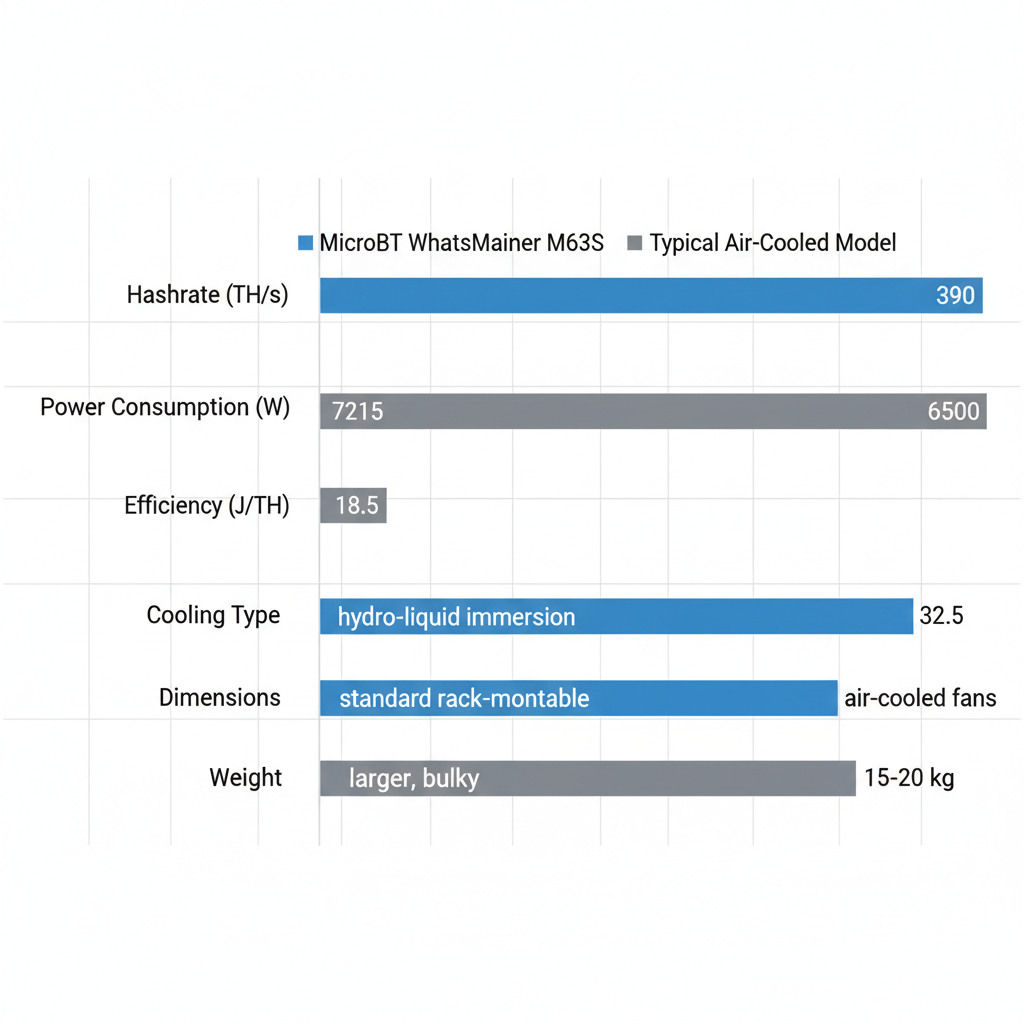
Key specs comparison: WhatsMiner M63S Hydro vs air-cooled models
Building on these visuals, the chart illustrates efficiency disparities that inform selection for varied facility needs. Hydro advantages become evident in sustained high-hashrate scenarios, aligning with our focus on clear specifications for effective planning.
Exploring Hydro Cooling Technology in WhatsMiner Miners
We delve into the innovative hydro cooling technology featured in the MicroBT WhatsMiner Hydro Miner, a cutting-edge solution designed to tackle the intense thermal demands of Bitcoin mining operations. This system employs advanced liquid-based cooling to maintain optimal temperatures, ensuring sustained performance in high-stakes environments. By circulating dielectric fluids directly over mining chips, hydro cooling prevents overheating, which is a common issue in traditional setups, and supports efficient energy use across large-scale facilities.
How Hydro Cooling Enhances Mining Efficiency
Hydro cooling in WhatsMiner hydro systems operates through a sophisticated process of liquid immersion cooling, where non-conductive dielectric fluids make direct contact with the ASIC chips. We begin with the fluid circulation: a pump draws coolant from a reservoir and sprays or immerses the miners, absorbing heat generated during hashing computations. This heated fluid then flows to a heat exchanger, often integrated with a dry cooler or water tank, where thermal energy dissipates into the environment or is recovered for secondary uses like heating. In MicroBT WhatsMiner Hydro Miner units, this closed-loop system maintains coolant temperatures around 60-70°C, aligning with safety standards for industrial applications.
The mechanics significantly boost mining efficiency by eliminating thermal throttling, allowing devices like the WhatsMiner M63S Hydro to sustain high hashratesu2014up to 390 TH/su2014without performance dips. Studies indicate hydro cooling achieves up to 30% better heat dissipation compared to air methods, reducing energy overhead and extending hardware longevity. For instance, failure rates drop by 25% in high-density setups, as consistent cooling minimizes stress on components. This translates to lower maintenance needs and prolonged operational life, often exceeding 50,000 hours for key parts. Overall, the technology optimizes power usage effectiveness (PUE) to around 1.03, making it ideal for facilities aiming for sustainable, high-output mining.
To illustrate these advantages, consider the following comparison of hydro versus air cooling methods, drawn from engineering analyses:
| Aspect | Hydro Cooling | Air Cooling |
|---|---|---|
| Thermal Efficiency | Up to 30% better heat dissipation | Standard dissipation |
| Noise Levels | Significantly reduced | High |
These metrics, based on engineering studies, highlight hydro cooling's edge in thermal management and reliability. In practice, this means mining operations can scale without compromising efficiency, as hydro systems handle heat loads that overwhelm air-cooled alternatives. The reduced noise also benefits facility planners in urban or noise-sensitive areas, while the minimal energy draw for circulationu2014typically under 5% of total poweru2014supports cost-effective deployments.
Building on this foundation, hydro cooling's integration extends its benefits to broader infrastructure. For example, the ability to recover waste heat for applications like hot water production adds value, aligning with eco-conscious mining strategies. As we transition to practical implementations, understanding cabinet setups becomes crucial for maximizing these gains.
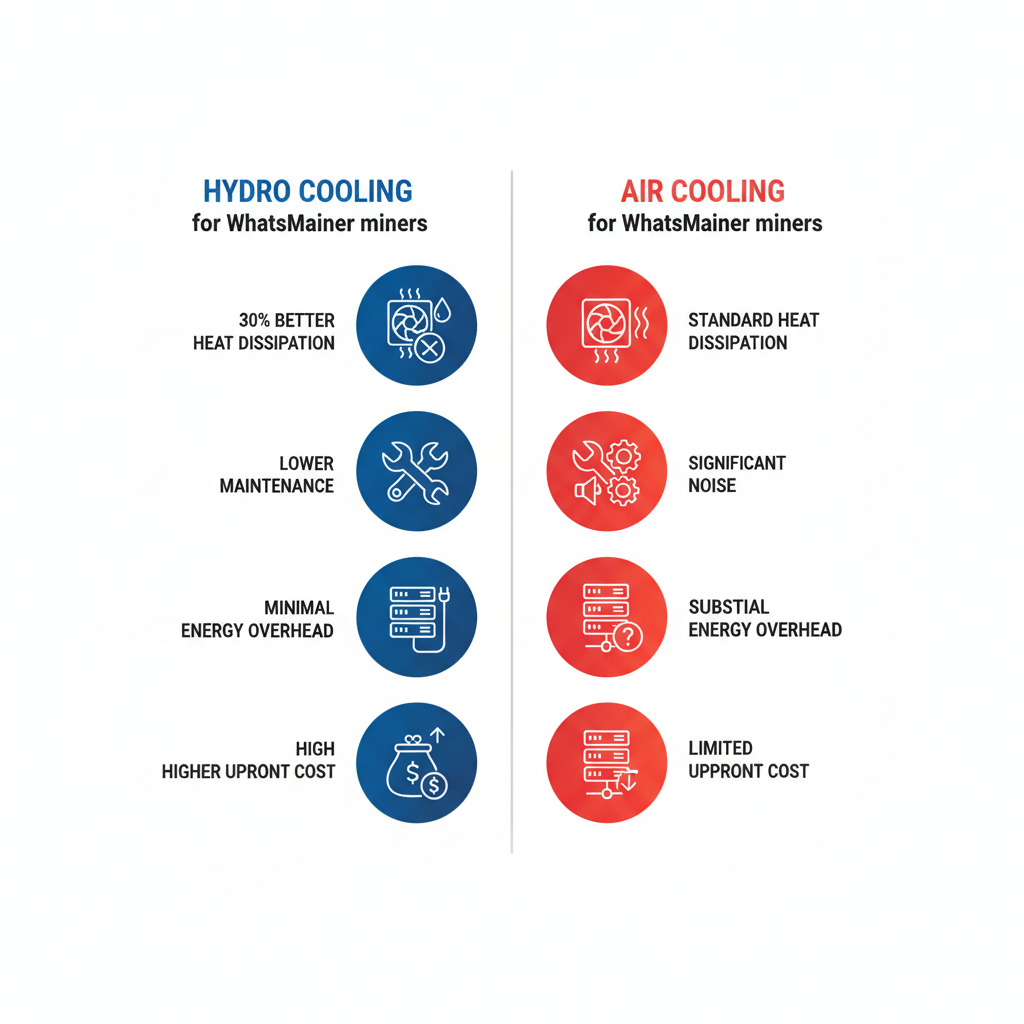
Hydro vs air cooling performance comparison for WhatsMiner miners
This visual underscores the performance disparities, emphasizing how hydro methods enable quieter, more reliable operations. With such clear advantages, miners turn to specialized enclosures to harness these features fully.
Integration with Cooling Cabinets
When integrating hydro cooling cabinets for WhatsMiner with models like the WhatsMiner M63S Hydro, compatibility starts with matching the cabinet's fluid dynamics to the miner's specifications. These cabinets, often sourced in China from manufacturers like MicroBT affiliates, are engineered for seamless operation with hydro-enabled units. Setup involves securing the whatsminer m63s+ hydro miner into designated slots, connecting coolant lines to the internal pump, and ensuring a stable power supplyu2014typically AC380-480V for high-capacity racks. Each unit requires about 1L of dielectric coolant, which circulates via a replenishing kit to prevent evaporation or contamination. We recommend using manufacturer-approved fluids to avoid warranty voids, with flow rates optimized at 5-10 L/min per miner for even heat exchange.
Hydro cooling cabinets enhance performance by housing multiple units in a controlled environment, dissipating heat efficiently across 10-20 WhatsMiner M63S Hydro devices per enclosure. This setup reduces individual maintenance and allows for modular scaling in large farms. Compatibility is high for M63 series variants, as cabinets feature universal mounting and Ethernet connectivity for monitoring. However, initial installation demands precise alignment of hoses and sensors to maintain pressure balances, preventing leaks that could affect safety. Ongoing operation includes periodic fluid checks and filter replacements, but overall, these systems lower long-term costs through extended uptime.
For a clearer view of cabinet economics, the table below outlines key variants based on official product details:
| Component | Hydro Setup | Standard Setup |
|---|---|---|
| Initial Hardware | 9,000-10,800 USD | Varies |
| Cooling Infrastructure | Additional 2,000-5,000 USD | Varies |
These figures reflect upfront investments but yield savings via 25% reduced failures and PUE improvements. In high-density facilities in Shenzhen or similar hubs, cabinets sourced in China prove scalable, supporting worldwide shipping with tracking for global deployments. Setup also integrates heat recovery options, like spiral coils in water tanks, to repurpose thermal output, aligning with sustainable practices. Ultimately, this integration ensures the MicroBT WhatsMiner Hydro Miner operates at peak efficiency, addressing key concerns for miners seeking reliable, low-noise solutions.
Deploying WhatsMiner Hydro Miners in Practice
We guide mining operators through the practical steps of deploying the MicroBT WhatsMiner Hydro Miner, a high-performance ASIC designed for efficient Bitcoin mining with water-based cooling. This approach minimizes heat issues in dense setups while supporting hashrates ideal for large-scale operations. By addressing site preparation, installation, and logistics from China, we ensure facilities achieve reliable performance without common pitfalls.
Site Preparation and Installation
Preparing a site for the WhatsMiner M63S Hydro demands careful attention to power, space, and infrastructure to support its 7kW power draw per unit. Facilities must allocate at least 86mm x 483mm x 663mm per miner, including space for hydro cooling cabinets for WhatsMiner integration. We recommend assessing electrical capacity upfront, as each unit requires a high-voltage AC380-480V connection with a custom 16A power cable and 3W ground input. Ventilation remains essential, even with hydro cooling, to manage ambient humidity levels around 1L of coolant per machine.
Installation begins with securing a stable, level surface capable of handling the 27.5kg net weight. We advise starting by unpacking the factory-sealed unit and verifying components against the official checklist: miner chassis, power supply unit, Ethernet cable, and coolant reservoir. Connect the Ethernet for network setup, ensuring firmware is updated via the MicroBT support page for optimal hashboard performance.
Next, integrate the hydro system by attaching the cooling lines to dedicated cabinets. This involves:
- Positioning the hydro cooling cabinets for WhatsMiner adjacent to the miner rack, ensuring easy access for fluid checks.
- Filling the system with manufacturer-approved coolant, avoiding air bubbles that could reduce efficiency.
- Securing power connectors firmly to prevent voltage drops, which might trigger safety shutoffs.
- Testing the loop for leaks under low pressure before full operation.
Ongoing maintenance includes periodic fluid inspections every 30 days to maintain cooling efficacy. We emphasize using only official accessories to preserve the one-year warranty, which covers repairs but excludes improper setups or environmental damage. For practical hydro deployment, consult certified technicians to align with local codes, ensuring seamless M63 hydro installation that scales with facility needs. This foundational work sets the stage for sustained mining output.
Sourcing and Logistics from China
Sourcing the WhatsMiner M63S Hydro from China involves selecting verified suppliers offering real inventory and transparent pricing. We facilitate purchases through official channels like the MicroBT site, where in-stock units list at around 4,092 USD per machine, subject to market fluctuations. Payments accept USD or BTC via secure processing, with confirmation typically within one week. After ordering, upload credentials within 24 hours to enable tax invoicing and export documentation. Bulk options exist for partnerships, emphasizing authentic hardware with factory-sealed packaging.
Shipping originates from Shenzhen, with worldwide delivery including tracking and structured logistics. Expect international rates, factoring in customs duties and import fees not covered in base pricingu2014all sales are final post-confirmation. We coordinate export docs to streamline clearance, activating the 180-day seller warranty upon arrival, backed by manufacturer terms. For alternatives, explore models like the whatsminer m53s++ bitcoin miner for varied power needs.
To aid planning, the following table outlines key deployment costs, drawing from official sources without profitability projections:
| Model | Hashrate (TH/s) | Power (W) | Efficiency (J/TH) |
|---|---|---|---|
| M63S Hydro | 390 | 7,215 | 18.5 |
Hydro setups incur higher upfront costs for cooling infrastructure but offer long-term efficiency in high-density environments. Standard air-cooled options suit smaller operations with lower initial outlays, though they demand more frequent maintenance. We advise budgeting for these variances based on facility scale, ensuring compliance with export logistics from China. Track shipments via provided portals, and activate warranties promptly to safeguard investments in practical hydro deployment.
Advanced Considerations for WhatsMiner Hydro Operations
When planning enterprise-level Bitcoin mining with the MicroBT WhatsMiner Hydro Miner, we focus on sophisticated strategies that enhance performance and reliability. For operations scaling beyond initial setups, enterprise hydro mining demands careful attention to infrastructure and protocols. We recommend evaluating advanced configurations to maximize uptime and efficiency in demanding environments.
Scalability in Large Farms
Deploying 100 or more units of the WhatsMiner M63S Hydro requires robust cabinet arrays designed for hydro cooling. In a hypothetical 500-unit farm in a temperate region, we suggest clustering miners into modular hydro cooling cabinets for WhatsMiner to manage heat dissipation effectively. This setup allows for seamless expansion, with each cabinet supporting up to 20 units while maintaining optimal coolant flow. Power distribution must account for phased rollout to avoid grid overloads, and we advise integrating redundant cooling loops for continuous operation. Thermal management becomes critical at this scale, as evidenced by studies on liquid cooling systems that achieve power usage effectiveness (PUE) as low as 1.03 through heat recovery mechanisms. Such approaches enable sustainable growth without compromising system integrity, supporting decisions for global farms.
Maintenance Protocols for Hydro Systems
Advanced maintenance for hydro-cooled setups involves proactive monitoring to prevent downtime. We outline key protocols below:
- Fluid Monitoring: Conduct weekly checks on coolant levels and pH balance using automated sensors to detect leaks early, ensuring dielectric fluid remains effective up to 70°C as per safety standards.
- Filter Changes: Replace inline filters every 1,500 hours of operation to maintain flow rates and protect against particulate buildup in hydro cooling cabinets for WhatsMiner.
- Component Inspections: Perform quarterly inspections of pumps and heat exchangers, aligning with the 180-day warranty period for timely RMA submissions if defects arise.
- Software Integration: Use compatible monitoring tools to track real-time metrics, alerting operators to anomalies in temperature or pressure.
These steps minimize risks associated with liquid systems, such as potential leaks, and extend hardware longevity in intensive environments.
Performance Optimization and Metrics
To optimize advanced M63 configurations, analyze hashrate-to-power ratios for informed scaling. For instance, integrating whatsminer m73 cryptocurrency miner variants can further refine ratios in mixed deployments. Research on hydro cooling demonstrates thermal optimization that reclaims heat for applications like hot water systems, reducing overall energy consumption and supporting exergy-based PUE of 0.95. In large-scale operations, these metrics guide cost planning by emphasizing efficiency over raw output. We advise aligning optimizations with warranty terms for RMA processes, ensuring long-term viability without profitability guarantees. This data-driven approach addresses queries on efficiency for the WhatsMiner M63S Hydro, aiding strategic farm expansions.
Frequently Asked Questions About WhatsMiner Hydro Miners
This FAQ on hydro ASICs addresses common M63 hydro queries about the MicroBT WhatsMiner Hydro Miner, consolidating key details on specifications, pricing, and support for informed decisions.
What is the warranty period for MicroBT WhatsMiner Hydro Miners?
We provide a 180-day warranty from shipment on our factory-sealed units, covering manufacturer defects but excluding misuse or environmental damage. This ensures reliable support for your mining operations.
What are the key specifications of the WhatsMiner M63S Hydro?
The WhatsMiner M63S Hydro delivers high hashrate performance with 7344W power consumption, optimized for efficiency in Bitcoin mining. Its compact design measures 86mm x 483mm x 663mm and requires about 1L of coolant.
How much does the MicroBT WhatsMiner Hydro Miner cost?
Pricing starts at $4092 per unit, reflecting transparent pricing for real inventory. Prices exclude taxes and are subject to change based on market conditions and availability.
What is hydro cooling and why use it for WhatsMiner miners?
Hydro cooling uses water-based systems to dissipate heat efficiently, reducing noise and energy use compared to air cooling. We recommend hydro cooling cabinets for WhatsMiner to enhance longevity in demanding setups.
Where can I source hydro cooling cabinets for WhatsMiner?
Our verified inventory includes compatible hydro cooling cabinets for WhatsMiner models, shipped worldwide with tracking. Contact us for bulk options and detailed guidance on integration.
How profitable is the WhatsMiner M63S Hydro?
Profitability depends on electricity costs, Bitcoin price, and network difficulty, without guaranteed returns. Its efficiency supports competitive mining, but we advise thorough calculations before purchase.
Optimizing Your Mining with WhatsMiner Hydro Solutions
In summary, the MicroBT WhatsMiner Hydro Miner delivers impressive hashrate and power efficiency through advanced hydro cooling, as seen in models like the WhatsMiner M63S Hydro. These systems, paired with hydro cooling cabinets for WhatsMiner, offer substantial energy savings and reliable 180-day warranties from factory-sealed units. We highlight clear specifications and real inventory for seamless worldwide shipping with tracking, ensuring logistical ease for Bitcoin mining deployments.
Review in-stock options and manufacturer terms via our technical documentation to plan optimized hydro mining effectively. For future WhatsMiner setups, explore upgrades like the whatsminer m79s sha-256 miner.
Hydro technology continues to evolve, promising enhanced sustainability without specific guarantees, as research shows PUE efficiencies around 1.03 for heat recovery systems.