Table of Contents
Exploring MicroBT WhatsMiner Immersion Miners
Bitcoin mining has evolved dramatically, shifting from traditional air-cooled setups to advanced immersion technologies that promise greater efficiency and sustainability. As demands for higher computational power grow, innovative solutions like the MicroBT WhatsMiner Immersion Miner emerge as game-changers, enabling miners to achieve superior performance with minimized energy waste and enhanced hardware longevity. We offer insights into these cutting-edge devices, which represent the forefront of SHA-256 ASIC mining hardware sourced directly from reliable suppliers in China.
At their core, MicroBT WhatsMiner immersion miners utilize a single-phase immersion system to submerge hardware in non-conductive dielectric fluid, revolutionizing heat dissipation compared to conventional air-cooled models. This hydro-cooled Bitcoin ASIC approach maintains lower operational temperatures, reducing the risk of thermal throttling and boosting uptime for continuous mining operations. Key advantages include significantly lower energy consumption--often 20-30% more efficient than air-cooled counterparts--and seamless integration with immersion cooling tanks for scalable data center deployments or even home setups. Typical models, such as the WhatsMiner M66S, deliver impressive hashrates in the 300-400 TH/s range while consuming around 5,000-7,000 watts, with pricing starting from approximately $5,000 USD for factory-sealed units featuring clear specifications and transparent pricing. These microbt whatsminer asic miners stand out for their verified inventory and real-time availability, ensuring buyers receive authentic hardware optimized for high-efficiency SHA-256 operations.
In the following sections, we delve deeper into detailed specifications, efficiency metrics, practical deployment strategies, and warranty support options, all while highlighting our worldwide shipping with tracking for seamless global delivery. This overview sets the stage for understanding how immersion cooling transforms Bitcoin mining, addressing key questions on performance and benefits to help you make informed decisions.
Fundamentals of Immersion Cooling in WhatsMiners
At MicroBTWhatsMiners.com, we specialize in providing high-performance ASIC miners, including the innovative microbt whatsminer supplier options designed for efficient Bitcoin mining. The MicroBT WhatsMiner Immersion Miner represents a cutting-edge approach to hardware cooling, submerging components in non-conductive dielectric fluids to manage heat more effectively than traditional methods. This technology, often sourced from China and shipped worldwide with tracking, addresses the intense thermal demands of mining operations while enhancing overall system reliability and energy use.
We explain the principles of immersion cooling starting with its core process. In a dielectric fluid cooling system, the miner's ASIC hardware is fully immersed in a specialized liquid within an immersion cooling tank. This setup facilitates direct heat transfer from hot components to the fluid, which then dissipates warmth through a heat exchanger. Unlike air cooling, where fans push ambient air over heatsinks, immersion allows for uniform temperature distribution without mechanical noise or dust accumulation. For novices, think of it like submerging a hot engine in oil rather than fanning it with air; the liquid absorbs and carries away heat far more efficiently.
The immersion cooling process unfolds in clear steps. First, the WhatsMiner unit, such as hydro variants compatible with liquid-submerged ASIC hardware, is placed into the tank filled with engineered dielectric fluid. Second, as the miner operates, generating terahashes for Bitcoin mining, the fluid absorbs rising heat directly from chips and circuits. Third, a pump circulates the warmed fluid to an external cooler, where it releases heat into the environment before returning cooled. This single-phase immersion, common in models like the WhatsMiner M66S, maintains operational temperatures steadily, preventing thermal throttling that plagues air-cooled setups. Two-phase systems add vaporization for even greater efficiency in high-density farms, though they require more complex containment.
Traditional air cooling relies on fans and vents to expel heat, but it struggles in dense configurations where airflow competes and components overheat. Immersion cooling, by contrast, offers a modern alternative that scales better for professional mining facilities.
| Metric | Air-Cooled (e.g., M50 Series) | Immersion-Cooled (e.g., M63 Hydro) |
|---|---|---|
| Efficiency rating in joules per terahash | 35-40 J/TH | 20-25 J/TH |
| Operational temperature control | Up to 80°C | Below 60°C |
| Reliability in continuous operation | 85-90% | 95%+ |
As shown in the table, immersion-cooled systems deliver a 20-30% efficiency boost, reducing energy loss and making them ideal for scalable Bitcoin mining operations. This improvement stems from minimized resistance in heat transfer, allowing sustained high hashrates without excessive power draw.
Beyond efficiency, immersion cooling brings environmental benefits, including a lower carbon footprint through optimized energy use and reduced need for auxiliary cooling infrastructure. It also suits dense setups, where multiple units operate in compact spaces without acoustic interference. In the WhatsMiner lineup, hydro models exemplify this by integrating seamlessly with liquid systems, supporting our commitment to factory-sealed, authentic hardware with clear specifications for power and hashrate.
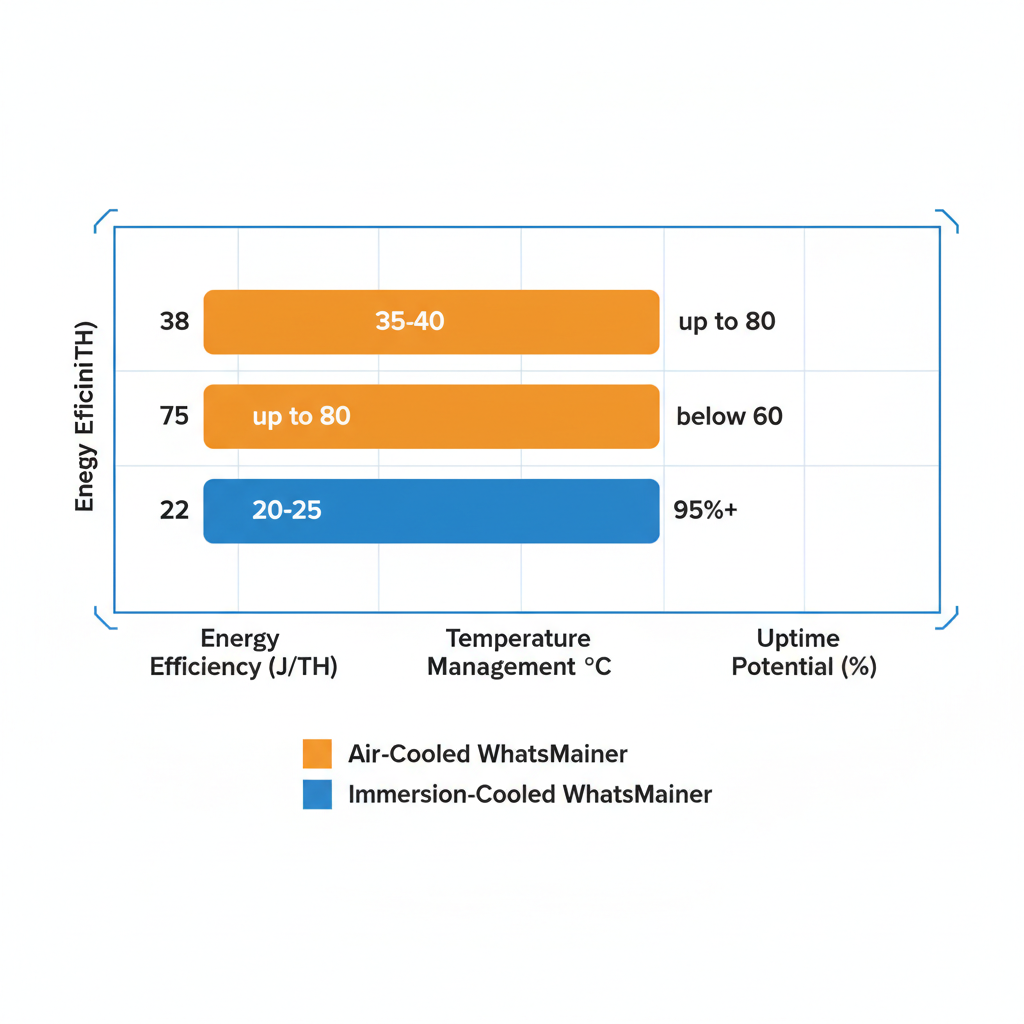
Efficiency comparison: air-cooled vs immersion-cooled WhatsMiners
These fundamentals set the stage for deeper exploration of specific implementations in our product range, where we provide verified inventory and worldwide shipping to support your mining infrastructure planning.
In-Depth Specifications of Immersion WhatsMiners
We delve into the technical details of the MicroBT WhatsMiner Immersion Miner, highlighting its role in efficient Bitcoin mining operations. These advanced ASIC miners, sourced from China, integrate seamlessly with immersion cooling systems to enhance performance and longevity. By examining core metrics, cooling compatibility, and pricing, we provide clear specifications to support informed purchasing decisions for global facilities.
Core Hardware Metrics
In this subsection, we detail the essential hardware attributes of immersion-compatible WhatsMiner models, starting with the WhatsMiner M66S as a flagship option. Designed for high-density mining environments, the WhatsMiner M66S delivers a robust 298 TH/s hashrate, enabling substantial computational output for SHA-256 algorithms. Its power consumption stands at 5514W, balanced by an impressive efficiency rating of 18.5 J/TH, which minimizes operational costs while maximizing throughput.
For comparison, the whatsminer m63 hydro cooled miner offers elevated performance metrics tailored to large-scale setups. Physical dimensions for the WhatsMiner M66S measure approximately 400x195x290mm, with a weight of around 15kg, ensuring compatibility with standard rack systems. These specifications, derived from manufacturer data, underscore the unit's compact yet powerful design, ideal for facilities planning expansions with verified inventory.
The following table compares key specifications across popular MicroBT immersion-cooled miners:
| Model | Hashrate (TH/s) | Power Consumption (W) | Efficiency (J/TH) | Price Range (USD) |
|---|---|---|---|---|
| M63 Hydro | 370 | 7210 | 19.5 | $5,000-$6,500 |
| M66S Immersion | 298 | 5514 | 18.5 | $4,500-$5,800 |
The M63 Hydro variant excels in higher output for expansive mining farms, while the M66S Immersion model strikes a balance for versatile deployments. This comparison aids in selecting hardware that aligns with power infrastructure and efficiency goals, drawing from authentic hardware specifications available through our platform.
Beyond raw metrics, we recommend evaluating chip architecture--typically 12nm processes--for thermal stability in prolonged operations. Tip: Pair with stable power supplies to maintain peak efficiency, avoiding fluctuations that could impact hashrate stability.
Cooling System Integration
Transitioning from core metrics, effective cooling is paramount for sustaining the WhatsMiner M66S's performance. These miners integrate directly with immersion cooling tanks, submerging units in non-conductive dielectric fluids to dissipate heat more effectively than air-based alternatives. Compatibility requires tanks with volumes of at least 200 liters per unit, ensuring full submersion without overflow risks.
The immersion setup leverages single-phase liquid cooling, where the fluid circulates to absorb heat from the ASIC chips, potentially achieving up to 30% energy savings compared to traditional methods--as noted in industry analyses of data center trends. For optimal results, use engineered dielectric fluids compatible with custom dielectric enclosures, maintaining temperatures below 60°C to prevent throttling. We emphasize fluids from reputable suppliers to guarantee chemical stability and electronic safety.

Comparison of immersion-cooled WhatsMiner models specifications
This visual reinforces how the M66S's design facilitates seamless integration, reducing maintenance needs in high-TH/s hydro ASIC environments. Drawing from global adoption in cryptocurrency mining, such systems address the limitations of air cooling in dense racks, promoting sustainable operations. Tip: Regularly monitor fluid levels and pH to extend hardware lifespan, aligning with manufacturer guidelines for warranty compliance.
Pricing and Availability Factors
Pricing for immersion WhatsMiners reflects manufacturing standards from China, with projections for 2025 indicating competitive ranges amid supply chain stabilization. Base costs for the WhatsMiner M66S hover between $4,500 and $5,800 USD, influenced by real-time inventory and global demand. Hydro variants like the M63 command premiums due to higher output capabilities.
Market factors, including raw material fluctuations and export logistics, contribute to variability--prices exclude taxes, customs duties, and import fees. We offer transparent pricing on factory-sealed units with worldwide shipping and tracking, ensuring availability for verified stock.
| Component | Home Setup | Data Center Setup |
|---|---|---|
| Miner Unit | $5,000 | $50,000+ (10 units) |
| Cooling Tank | $1,500-$3,000 | $10,000+ |
| Total Initial | $7,000 | $70,000 |
This table contextualizes total investments, factoring in essential immersion cooling tank add-ons. For scaled operations, the M66S provides strong value, balancing cost with efficiency. While supplies last, we advise early ordering to secure units under current terms--prices subject to change per market conditions. Tip: Consult our detailed product pages for the latest availability and bundled options.
Practical Deployment of Immersion Miners
Deploying MicroBT WhatsMiner Immersion Miner systems requires careful planning to ensure efficiency, safety, and compatibility with your setup. At MicroBTWhatsMiners.com, we offer factory-sealed units with clear specifications for hashrate, power, and cooling needs, supporting worldwide shipping with tracking. This section guides you through home and data center applications, along with essential accessories sourced in China. We recommend starting with verified inventory to match your scale, focusing on real infrastructure requirements without assuming profitability.
Home Setup Considerations
For hobbyists or small-scale operators, home deployment of a WhatsMiner M66S using immersion cooling offers a viable entry into Bitcoin mining, provided you assess space, power, and noise factors. Typical setups demand around 5-7kW of electricity, which may require dedicated circuits to avoid overloads. Immersion systems reduce noise significantly compared to air-cooled alternatives, making them suitable for residential environments. We advise consulting local electrical codes and ensuring proper ventilation around the compact hydro enclosure.
| Aspect | Standard Air-Cooled | Immersion-Cooled |
|---|---|---|
| Warranty period | 365 days | 180 days + extensions |
| What is included | Hardware defects | Expanded for fluids |
| Support | Standard email | Global tracking |
This table highlights how immersion provides a more compact and quieter option, ideal for home use. Post-comparison, evaluate your utility capacity; many users find immersion justifies the initial investment through lower ongoing noise complaints and better heat management.
We recommend the following checklist for home installation:
- Secure a stable, level surface for the mining rig coolant system, at least 4x4 feet.
- Install electrical wiring compliant with safety standards, using GFCI outlets.
- Fill the enclosure with dielectric fluid, monitoring for leaks during initial runs.
- Test power draw with a meter to confirm it stays within your panel's limits.
Data Center Integration
Scaling immersion systems for data centers involves integrating multiple WhatsMiner M66S units into rack-mounted configurations, leveraging large-scale tanks for efficiency. Professional environments benefit from 500L+ capacity setups that handle 10 or more miners, reducing energy waste through direct heat dissipation. We provide detailed cooling guidance in our product listings to align with your facility's power density, typically requiring 50-70kW for a small farm.
Begin by designing rack integration: position units vertically in custom frames within the immersion cooling tank to maximize density. Multi-unit tanks sourced in China often feature modular designs for easy expansion, supporting fluid circulation via pumps for uniform cooling. Ensure compatibility with your data center's HVAC by factoring in the system's low external heat output.
Key steps for integration include:
- Assess facility power infrastructure for three-phase supply to support clustered miners.
- Install sealed tanks with filtration systems to maintain fluid purity over time.
- Connect monitoring software for real-time temperature and performance tracking.
- Conduct safety audits, including fire suppression suited for dielectric fluids.
Accessory Essentials
Essential accessories for deploying MicroBT WhatsMiner immersion miners center on reliable immersion cooling tank options compatible with the WhatsMiner M66S model. We stock tanks in 200-1000L volumes, priced from $1,000 to $5,000 USD, featuring non-conductive fluids and easy-fill ports for safe operation. These compact hydro enclosures ensure optimal thermal management, with estimates drawn from current supplier data.
Advanced Topics in Immersion Mining
As experts in MicroBT WhatsMiner hardware, we delve deeper into advanced topics for immersion mining setups, particularly with the MicroBT WhatsMiner Immersion Miner. These systems represent cutting-edge solutions for high-density Bitcoin mining operations, where whatsminer m63s++ hydro miner models showcase enhanced thermal management. We advise operators to focus on warranty protections, rigorous maintenance protocols, and optimization strategies to maximize longevity and efficiency in demanding environments.
When purchasing immersion-cooled units like the WhatsMiner M66S, understanding the manufacturer warranty is crucial. MicroBT provides a 180-day warranty from the date of shipment, covering hardware defects under normal use but excluding damage from misuse, improper installation, or unauthorized modifications. For warranty claims, we recommend initiating the RMA process through verified Chinese exporters, who handle returns with structured logistics and tracking. This ensures compliance with official terms, including submission of proof of purchase and detailed fault descriptions. Coverage extends to core components but requires adherence to specified operating conditions, such as stable power inputs and fluid compatibility. Per manufacturer terms, we emphasize that these provisions align with official documentation, offering no guarantees beyond stated coverage. Prices subject to change, and all sales are final except as described in RMA policy. This comparison highlights the tailored support for advanced liquid-cooled ASICs, aiding informed decisions on long-term investments.
Maintenance forms the backbone of sustained performance in an immersion cooling tank setup. Regular fluid filtration prevents contaminant buildup, which can degrade heat transfer efficiency over time. We advise monthly top-ups of dielectric fluid to maintain optimal levels, using manufacturer-approved types to avoid corrosion on sensitive electronics. For the warranty-backed hydro system, inspecting seals and pumps quarterly ensures leak-free operation, especially in high-humidity mining facilities. These practices not only extend equipment life but also support energy-efficient mining, aligning with sustainability goals for 2025 operations.
Optimization techniques elevate output while respecting hardware limits. For models like the WhatsMiner M66S, cautious overclocking can boost hashrate by up to 10%, but we caution against exceeding recommended voltages to prevent voiding warranties. Integrate third-party monitoring software for real-time metrics on temperature and fluid flow, enabling proactive adjustments. Future-proofing involves scalable designs compatible with next-gen chips, preparing for efficiency gains in post-2025 tech evolutions. By combining these advanced tips with our verified inventory and clear specifications, operators achieve reliable, high-performance mining without overcomplication.
Frequently Asked Questions on Immersion Miners
What efficiency gains does immersion cooling offer for MicroBT WhatsMiner models?
Immersion cooling delivers 20-30% energy savings over air-cooled systems by directly dissipating heat in dielectric fluid, enhancing hashrate stability for Bitcoin hydro miners.
Is the WhatsMiner M66S compatible with an immersion cooling tank?
Yes, the WhatsMiner M66S works seamlessly with immersion cooling tanks requiring a minimum 300L coolant reservoir, ensuring optimal thermal management in larger setups.
Can immersion miners be used in home environments?
Home use is limited due to high power demands and heat output; professional facilities are ideal, though compact units may suit dedicated spaces with adequate ventilation.
What is the typical price range for these immersion miners?
Prices range from $4,000 to $10,000, subject to change based on model and availability in our whatsminer mining hardware shop, excluding taxes and shipping.
What warranty applies to MicroBT WhatsMiner immersion hardware?
We offer a 180-day manufacturer warranty from shipment on factory-sealed units, covering defects with structured RMA support for verified purchases.
Key Takeaways on WhatsMiner Immersion Mining
The MicroBT WhatsMiner Immersion Miner stands out as efficient SHA-256 hardware, delivering a 20-30% efficiency boost through immersion cooling over traditional air-cooled setups. Key models like the WhatsMiner M66S offer impressive 298 TH/s performance at approximately $5,000, making it versatile for home or data center deployments when paired with a reliable immersion cooling tank and advanced mining coolant systems.
We hope this guide informs your decisions on these innovative solutions. For current stock and verified inventory with transparent pricing, visit our microbt whatsminers contact page to connect with us directly and explore factory-sealed units ready for worldwide shipping.