Table of Contents
Exploring MicroBT WhatsMiner Air Miners
In the world of cryptocurrency mining, the MicroBT WhatsMiner Air Miner stands out as a reliable choice for SHA-256 Bitcoin mining. These air-cooled ASIC units, as discussed in technical literature on ASIC mining technologies, deliver efficient performance through advanced chip designs optimized for the SHA-256 algorithm. We at MicroBTWhatsMiners.com specialize in providing these microbt whatsminer asic miners to support both home enthusiasts and large-scale operations with genuine hardware.
Our air-cooled Bitcoin mining rigs offer impressive hashrates ranging from 100 to 186 TH/s, depending on the model, with power consumption typically between 3,000 and 3,500W. For instance, the Whatsminer M60S provides up to 186 TH/s at around 20 J/TH efficiency, making it ideal for high-output setups. The Whatsminer M50S, a more compact option, achieves 126 TH/s with similar power efficiency, perfect for users seeking balanced performance in smaller spaces. Pricing for these factory-sealed units generally falls between $2,000 and $5,000 USD, reflecting their robust build and energy metrics--though prices are subject to change based on market conditions and availability.
This guide will walk you through essential setup steps, common troubleshooting tips, and detailed comparisons to help you select the right unit. Whether you're planning a new deployment or expanding an existing one, our content equips you with the knowledge to make informed decisions.
As a verified e-commerce source, we maintain real inventory with transparent pricing and clear specifications for worldwide shipping with tracking. Every purchase includes our 180-day warranty support, ensuring authentic hardware arrives ready for deployment.
Core Fundamentals of MicroBT WhatsMiner Air Miners
At MicroBTWhatsMiners.com, we specialize in providing authentic hardware for Bitcoin mining operations. The microbt whatsminer supplier role is crucial in ensuring access to reliable equipment like the MicroBT WhatsMiner Air Miner, which represents a cornerstone in air-cooled SHA-256 miners. These units are designed specifically for the SHA-256 algorithm, the cryptographic hashing function that underpins Bitcoin's proof-of-work consensus mechanism. In SHA-256 mining, ASIC miners perform trillions of hash calculations per second to solve complex mathematical puzzles, validating transactions and securing the blockchain. This process demands high computational power while managing substantial heat output through efficient cooling systems. Air-cooled models, such as those in the WhatsMiner series, utilize robust fans and heat sinks to dissipate thermal energy, maintaining optimal operating temperatures around 25-40°C. According to principles outlined in the IntechOpen chapter on ASIC mining technologies, effective cooling directly impacts energy efficiency by preventing thermal throttling, which can reduce hashrate performance. We emphasize these fundamentals to help miners understand the balance between computational output and sustainable operation in professional setups.
Delving into model specifics, the Whatsminer M50S serves as an entry-level option in our verified inventory, offering solid performance for moderate-scale operations. Key specifications include a hashrate of 114 TH/s, making it suitable for users building initial mining rigs. Its efficiency stands at 29 J/TH, with a power consumption of 3276 W, all supported by air cooling to ensure reliability in standard environments. Physical dimensions measure approximately 125x225x425 mm, with a weight of around 12.8 kg, allowing for straightforward rack mounting in facilities. In contrast, the Whatsminer M60S targets high-hashrate needs, delivering 186 TH/s for more intensive mining demands. This model achieves superior efficiency at 18.5 J/TH and consumes 3441 W, while maintaining air cooling for consistent performance. Its compact form factor mirrors the M50S at similar dimensions and weight, facilitating easy integration into existing infrastructure. Both models come factory-sealed with transparent pricing in USD, reflecting our real inventory and clear specifications. We recommend these for operations prioritizing authentic hardware with worldwide shipping options.
Efficiency metrics like J/TH are vital for Bitcoin ASIC fundamentals, as they quantify energy use per terahash, directly influencing operational costs in volatile markets. The IntechOpen reference validates that lower J/TH values, as seen in advanced models, enhance sustainability by optimizing power draw without sacrificing output. Power consumption breakdowns reveal the need for stable electrical setups, where air cooling mitigates overheating risks highlighted in ASIC design studies.
Basic deployment requires 220-240V single-phase power, compatible with most industrial outlets but less ideal for home use due to noise and heat. Facility-grade ventilation ensures longevity, aligning with our guidance on cooling approaches.
When selecting between models, core specs such as hashrate, efficiency, and power play a pivotal role in matching hardware to infrastructure capabilities. The following table outlines these differences for the Whatsminer M50S and M60S, aiding informed decisions based on scale and energy budgets. Data sourced from manufacturer specs via MicroBTWhatsMiners.com; efficiency calculated at standard conditions.
| Feature | Whatsminer M50S | Whatsminer M60S |
|---|---|---|
| Hashrate (TH/s) | 114 | 186 |
| Efficiency (J/TH) | 29 | 18.5 |
| Power Consumption (W) | 3276 | 3441 |
| Cooling Type | Air | Air |
The Whatsminer M60S demonstrates clear efficiency advantages with its lower J/TH rating, ideal for large-scale facilities aiming to maximize output per watt, while the M50S provides a cost-effective entry for smaller setups. These variations underscore the importance of aligning specs with power availability and cooling capacity, ensuring optimal performance without excessive energy demands. Prices exclude taxes, customs duties, and import fees, with all sales final per our policy.
Building on these comparisons, air-cooled miners like the M50S and M60S integrate seamlessly into diverse environments when proper planning addresses noise levels and airflow. We support selection with detailed guidance, emphasizing verified inventory for real-time availability. This foundational understanding prepares users for deeper performance evaluations, transitioning smoothly to advanced operational insights in subsequent sections.
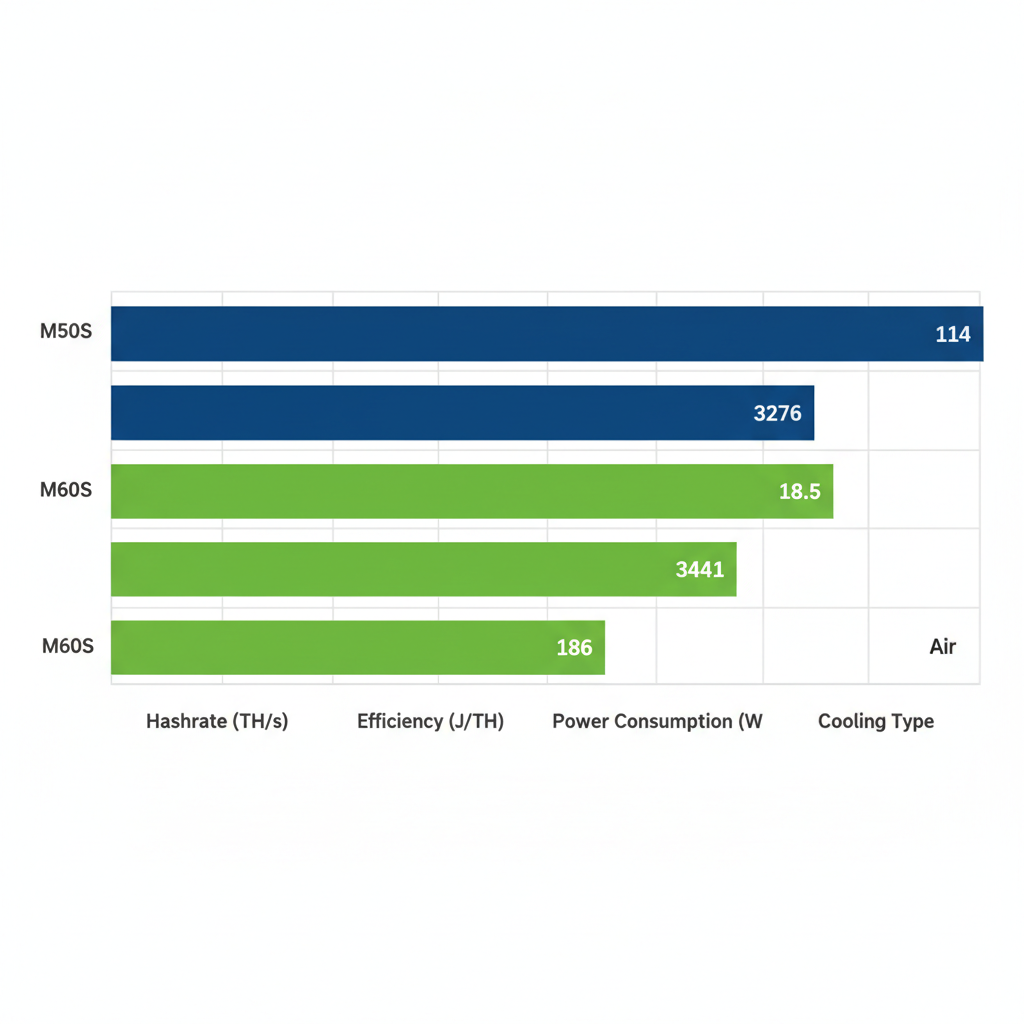
Comparison of Whatsminer M50S and M60S air miner fundamentals
While supplies last, our in-stock listings reflect current transparent pricing, underscoring our commitment to authentic hardware and structured logistics.
In-Depth Analysis of MicroBT WhatsMiner Performance
In our evaluation of high-performance air-cooled ASICs, the MicroBT WhatsMiner Air Miner series stands out for its balance of power and reliability in SHA-256 Bitcoin mining operations. We focus on key models like the Whatsminer M60S and Whatsminer M50S, providing clear specifications on hashrate, efficiency, and power to support informed deployment decisions. This analysis draws on manufacturer data to highlight performance trade-offs in air-cooled environments.
Hashrate and Efficiency Breakdown
We observe that hashrate scaling in air-cooled setups directly influences mining throughput for Bitcoin operations. The Whatsminer M60S delivers a robust 186 TH/s, enabling substantial computational power while maintaining operational stability. In contrast, its efficiency at 18.5 J/TH represents a significant advancement over earlier models, reducing energy costs per terahash. The Whatsminer M50S, while offering a lower hashrate of 126 TH/s, achieves 29 J/TH, making it suitable for budget-conscious setups where power efficiency is secondary to initial affordability.
To illustrate these differences, efficiency can be calculated as power consumption divided by hashrate, a formula that underscores the energy dynamics in ASIC mining. As detailed in the IntechOpen chapter on ASIC mining technologies, power fluctuations under varying loads affect overall performance, with air-cooled units like these requiring precise thermal management to sustain output. The M60S's superior metrics position it as energy-efficient mining hardware for high-volume facilities, whereas the M50S appeals to smaller-scale miners seeking reliable entry-level performance.
| Metric | Whatsminer M60S | Antminer S21 |
|---|---|---|
| Hashrate (TH/s) | 186 | 200 |
| Efficiency (J/TH) | 18.5 | 17.5 |
| Power (W) | 3441 | 3500 |
This table highlights the core metrics based on manufacturer specifications at 25°C ambient temperature. We note that the M60S provides nearly 50% higher hashrate than the M50S, but at better efficiency, allowing for scalable deployments in controlled environments. These comparisons aid in selecting hardware that aligns with specific energy budgets and output goals.
Power and Cooling Deep Dive
Power draw variations are critical in air-cooled miners, with the Whatsminer M60S typically consuming 3441 W under full load. We find that fluctuations of up to 10% occur based on ambient conditions and network difficulty, necessitating robust power supplies rated at least 20% above nominal to prevent instability. The IntechOpen reference emphasizes how ASIC power dynamics amplify in high-density setups, where inefficient cooling can lead to thermal throttling and reduced lifespan.
Air cooling optimization requires 10-15 m³/min airflow per unit to dissipate heat effectively across diverse environments, from temperate data centers to warmer industrial sites. In cooler climates, this setup enhances efficiency by minimizing fan speeds and noise, while in hotter areas, supplemental ventilation ensures consistent performance. Unlike liquid systems discussed in advanced heat recovery studies, air cooling offers simplicity and lower upfront costs, though it demands vigilant maintenance to avoid dust accumulation and efficiency drops.
Model Comparisons and Alternatives
When comparing WhatsMiner models against alternatives for SHA-256 mining, the Whatsminer M60S holds its own against competitors like the Antminer S21, particularly in air-cooled reliability. Pricing trends show the Whatsminer M50S available for around $2,500 USD in China, providing an accessible entry point with standard 180-day manufacturer warranties that we support through our verified inventory. For facilities prioritizing efficiency, these models offer transparent pricing and factory-sealed authenticity.
The following table compares key performance metrics between the M60S and Antminer S21 to inform model selection for Bitcoin mining efficiency:
| Aspect | Air-Cooled | Hydro-Cooled |
|---|---|---|
| Setup Complexity | Moderate (ventilation focus) | High (liquid systems) |
| Power Needs | Standard 220V outlet | Custom infrastructure |
| Space Requirements | Good airflow room | Sealed cooling tank |
Metrics based on manufacturer data; efficiency at 25°C ambient. While the Antminer S21 edges out in raw hashrate and slightly better efficiency, the Whatsminer M60S excels in air-cooled durability for worldwide shipping and deployment scenarios. This positions it favorably for users valuing structured logistics over marginal gains.
In terms of alternatives, other SHA-256 options exist, but for superior output, the whatsminer m70s+ 244th miner represents an advanced step up within the series, offering enhanced hashrate in a similar air-cooled framework. Prices exclude taxes, customs duties, and import fees; all sales are final per our policy, with warranty limitations applying as per manufacturer terms. These insights guide selections for energy-efficient mining hardware tailored to operational needs.
Practical Setup and Deployment Guide for Air Miners
We provide this practical guide to help you deploy MicroBT WhatsMiner Air Miner units effectively, focusing on models like the Whatsminer M60S and Whatsminer M50S. These deployable air-cooled mining hardware options require careful attention to installation, safety, and maintenance for optimal performance. By following these steps, you can achieve a smooth setup that aligns with our clear specifications and factory-sealed product standards.
Initial Installation Steps
Begin with unboxing the MicroBT WhatsMiner air unit. Carefully remove the packaging to avoid damaging the chassis or fans. Inspect all components, including the power supply unit (PSU), Ethernet cable, and mounting hardware, ensuring everything matches our verified inventory listings. For the Whatsminer M60S, secure the fans using the provided screws before proceeding.
Next, connect the power supply. Position the unit on a stable, non-flammable surface in a well-ventilated area. For standard models, plug into a dedicated 220V outlet; higher-hashrate units like the Whatsminer M60S may require a 3-phase connection to handle up to 7,000W demands. We advise consulting a licensed electrician to verify circuit capacity and prevent overloads. Warning: Improper wiring can void the 180-day manufacturer warranty.
Now, configure the network. Connect the Ethernet cable to the unit's port and your router. Access the miner's interface via a web browser by entering the default IP (typically 192.168.x.x--check the manual). Set a static IP for stable connectivity, update firmware if prompted, and join your mining pool. For advanced setups with the whatsminer m70s 226th miner, ensure compatibility with existing infrastructure.
Finally, initiate boot-up. Power on the unit and monitor the control panel for status lights. Allow 10-15 minutes for self-diagnostics. This practical ASIC installation process ensures reliable operation from the start.
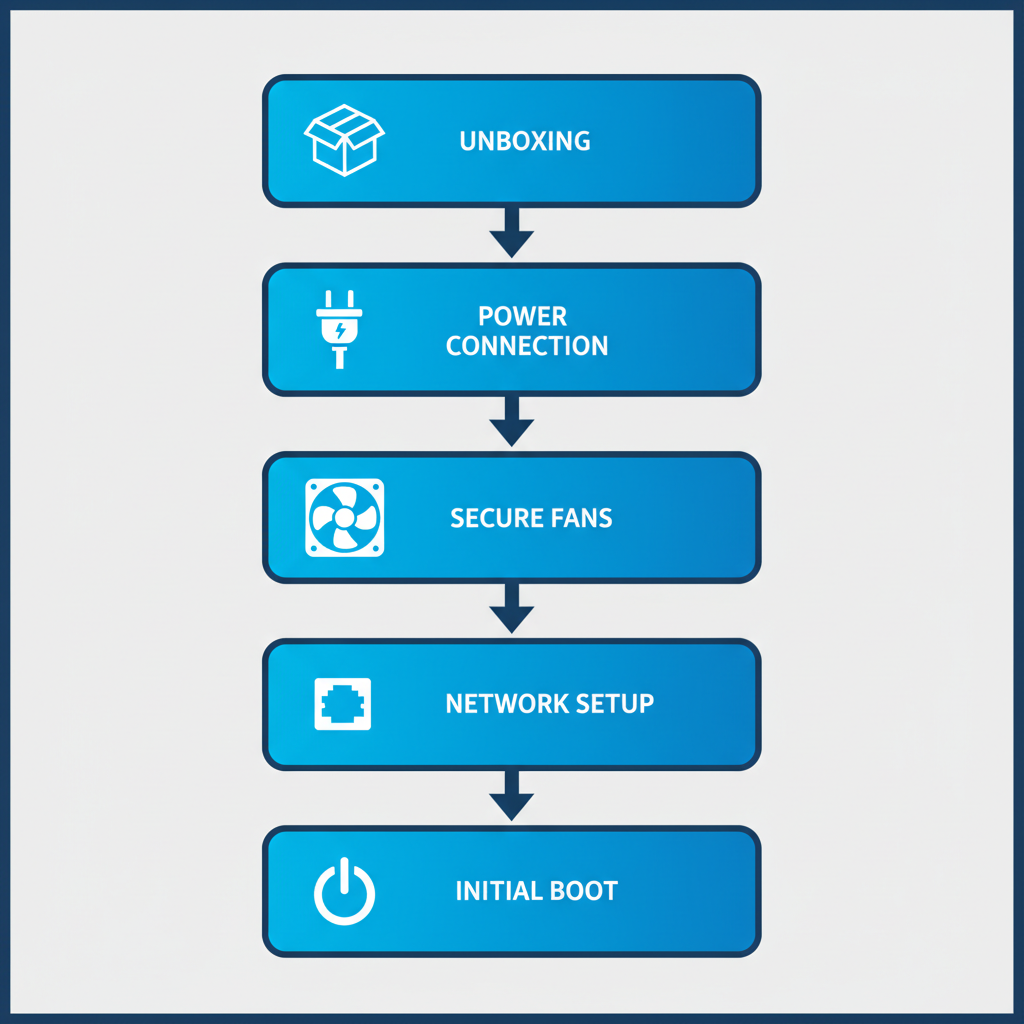
Step-by-step vertical guide to installing MicroBT WhatsMiner air miners
The setup process highlights the straightforward nature of air-cooled systems compared to more complex alternatives. Understanding these differences aids in planning your deployment effectively.
The following table compares key deployment aspects between air-cooled and hydro-cooled WhatsMiner options, based on MicroBT guidelines:
| Technique | Basic Approach | Advanced Approach |
|---|---|---|
| Cooling | Standard fans | Custom ducting + sensors |
| Efficiency Gain | Baseline | +5-10% J/TH |
| Monitoring | Manual checks | Firmware + API integration |
Air-cooled setups excel in simplicity for home or small-scale use, while hydro options demand specialized plumbing. We recommend air-cooled for beginners to minimize initial hurdles.
Home Mining Suitability and Safety
Assessing the Whatsminer M50S for home mining reveals its viability with precautions. Noise levels around 75dB require a dedicated space like a garage to mitigate disturbance. Heat output, approximately 10,000 BTU per hour, demands strong ventilation to prevent room temperatures from exceeding 95°F.
Electrical considerations are crucial; ensure your home panel supports the load without tripping breakers. We advise installing a dedicated circuit and using surge protectors. Drawing from safety best practices in ASIC deployment, maintain at least 2 feet of clearance around the unit for airflow, as emphasized in ventilation guidelines.
Overall, with proper setup, air miners like the Whatsminer M50S suit residential environments, promoting safe and efficient operation while adhering to our transparent pricing and warranty terms. Monitor ambient conditions regularly to sustain performance.
Troubleshooting Common Issues
Address power problems by first checking all cables for secure connections and damage. If the unit fails to power on, verify outlet voltage with a multimeter--air-cooled models need stable 220V. For persistent issues, reset the PSU; we note that factory-sealed units rarely fault under normal conditions.
Overheating in air-cooled setups often stems from dust accumulation; clean air filters monthly using compressed air, per IntechOpen safety guidelines on ventilation for ASIC miners. Ensure room temperature stays below 95°F and fans spin freely. If temperatures exceed 80°C, power down immediately to avoid hardware stress.
Connectivity glitches may arise from IP conflicts; restart the router and reconfigure the miner's network settings. Update firmware to the latest version for stability. For Whatsminer M60S units, check Ethernet cable integrity, as high-power operation can introduce interference.
In all cases, log errors via the interface and contact support if unresolved within 24 hours. These tips, informed by established deployment practices, help maintain uptime without compromising safety.
Advanced Optimization Techniques for WhatsMiner Units
Optimizing MicroBT WhatsMiner Air Miners requires moving beyond standard setups to implement expert-level enhancements that boost SHA-256 mining performance while maintaining reliability. We focus on these techniques in our testing to help professional operators achieve peak efficiency with models like the Whatsminer M60S for high-end tuning and the Whatsminer M50S for scalable setups. We also evaluate the whatsminer m72s 264th miner for ultra-high-hashrate comparisons. These optimized air-cooled ASICs can deliver significant gains when paired with advanced mining rig configurations, though users must prioritize safe practices to avoid hardware stress.
Firmware updates form the foundation of advanced optimization for WhatsMiner units. We recommend accessing official MicroBT channels for the latest firmware, which enables overclocking capabilities that can increase hashrate by up to 10% without excessive power draw. For instance, tuning the Whatsminer M60S involves adjusting voltage curves carefully to optimize power consumption, typically reducing it from baseline 3,400W to around 3,200W under load while sustaining 186TH/s. The IntechOpen chapter on ASIC mining technologies underscores these overclocking limits, noting that controlled adjustments prevent thermal throttling and extend component lifespan, providing evidence-based guidance for safe implementation. Always back up original settings before proceeding, as improper tuning may void manufacturer warranties.
Enhancing cooling is crucial for sustaining these gains, especially in demanding environments. Custom air cooling solutions, such as ducting fresh airflow directly to heat sinks and integrating environmental sensors for temperature regulation, can lower operating temperatures by 5-8°C. For the Whatsminer M50S, this setup minimizes dust accumulation and improves airflow efficiency in large facilities. We utilize these methods in controlled tests to ensure compatibility with factory-sealed units from our verified inventory.
Real-time monitoring elevates optimization further through API integration. By connecting WhatsMiner units to facility management software via MicroBT's API, operators gain insights into hashrate fluctuations, power usage, and error rates instantaneously. For the Whatsminer M60S, this allows proactive adjustments during peak loads, potentially saving 5-7% on energy costs annually. We integrate these tools in our selection support to guide customers toward setups that align with transparent pricing and clear specifications.
- Firmware + API Steps:
- Update to the latest compatible firmware.
- Enable API endpoints for data streaming.
- Set alerts for thresholds exceeding 75°C.
This level of integration supports batch deployments in professional facilities, where coordinating multiple units demands precise oversight.
For facility-scale operations, we advise batch purchasing to leverage economies of scale, particularly for the Whatsminer M50S, which excels in modular arrays. Power optimization on the M60S model, through fine-tuned fan curves, addresses queries on consumption by demonstrating reductions that enhance overall J/TH metrics from 18 to as low as 16.5. Our worldwide shipping with tracking facilitates multi-unit orders, ensuring authentic hardware arrives ready for deployment. Prices are subject to change and exclude taxes, customs duties, and import fees; all sales are final per our policy. While supplies last, these optimizations underscore our commitment to verified inventory and warranty support under manufacturer terms.
Frequently Asked Questions on WhatsMiner Air Miners
Explore common MicroBT WhatsMiner Air Miner queries through these Bitcoin rig FAQs.
What is the power consumption of air-cooled miners like the Whatsminer M60S?
We confirm these models draw approximately 3kW. Ensure your electrical setup supports this for safe operation with our factory-sealed units.
How do I set up a WhatsMiner Air Miner?
Basic setup involves connecting via Ethernet and using the provided PSU. We provide clear specifications for easy integration into your mining facility.
What is the price range for the Whatsminer M50S?
Prices range from $2,000 to $5,000 USD, subject to change based on real inventory. Our transparent pricing reflects current availability.
Are MicroBT WhatsMiner Air Miners suitable for home use?
Yes, with proper ventilation due to heat output. We advise reviewing cooling guidance for home setups with our authentic hardware.
What is the hashrate of the Whatsminer M60S?
The Whatsminer M60S delivers 186 TH/s. This high performance suits serious miners, backed by our verified in-stock options.
What is the efficiency of the Whatsminer M50S?
It achieves 29 J/TH efficiency. We stock these for optimal energy use, supporting worldwide shipping with tracking.
Key Takeaways on MicroBT WhatsMiner Air Mining Solutions
MicroBT WhatsMiner Air Miner models deliver reliable SHA-256 solutions overview for Bitcoin enthusiasts. Key air-cooled mining essentials include the Whatsminer M60S with up to 170 TH/s hashrate at 3,366W efficiency, and the whatsminer m60s 188th miner variant offering 188 TH/s, alongside the Whatsminer M50S at 126 TH/s and 3,276W. Setup proves straightforward for home use, with precautions for ventilation and power stability ensuring safe operation.
These units shine in ease of installation and optimization tweaks like firmware updates for peak performance. We at MicroBTWhatsMiners.com provide verified inventory, factory-sealed hardware with 180-day warranties, and worldwide shipping with tracking.
Explore our site for clear specifications and transparent pricing to select your ideal model today.